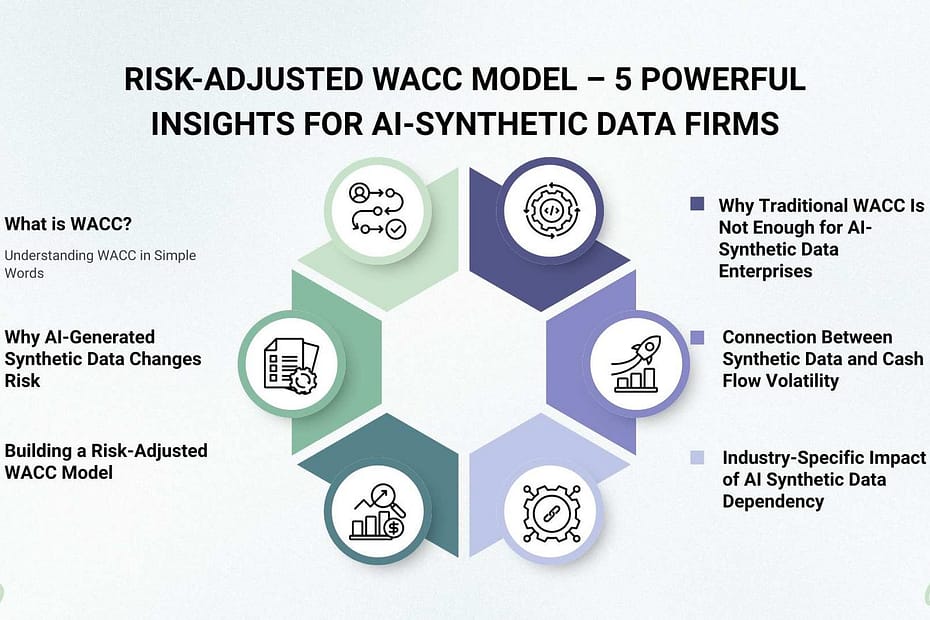
Risk-Adjusted WACC Model – 5 Powerful Insights for AI-Synthetic Data Firms is an important financial concept for modern companies that depend heavily on artificial intelligence–generated data for their business decisions. Today, many AI-driven enterprises use synthetic data for training models, forecasting, simulations, and decision-making. When more than 50% of operational intelligence depends on such data, traditional financial models are no longer enough.
As a teacher, I want to explain this topic in a very simple and step-by-step way. We will first understand what WACC is, then why AI-generated synthetic data creates new risks, and finally how to adjust WACC to correctly reflect those risks. This explanation is suitable for students, freshers, and beginners in finance, economics, or AI-driven business strategy.
What is WACC? (Foundation First)
Understanding WACC in Simple Words
WACC, or Weighted Average Cost of Capital, is the average cost a company pays to raise money. Companies usually raise money from two main sources: equity (shareholders) and debt (loans or bonds). Each source has a cost, and WACC combines them based on their proportion in the company’s capital structure.
In basic terms, WACC answers one question:
“What is the minimum return this company must earn to satisfy investors and lenders?”
The standard WACC formula is:
WACC = (E/V × Cost of Equity) + (D/V × Cost of Debt × (1 − Tax Rate))
This formula works well for traditional businesses, but it assumes risks are stable and well-understood. That assumption breaks when a company relies heavily on AI-generated synthetic data.
Why AI-Generated Synthetic Data Changes Risk
Nature of Synthetic Data Dependency
AI-generated synthetic data is not collected from the real world in the usual way. Instead, it is created by models that simulate reality. When such data drives more than 50% of operational intelligence, the company faces unique and layered risks.
First, there is model risk. If the AI model generating the data is biased, poorly trained, or outdated, decisions based on that data can be systematically wrong. Second, there is validation risk. Synthetic data may look statistically correct but may fail in real-world edge cases. Third, there is regulatory and ethical risk, especially in industries like healthcare, finance, or public policy, where regulators may question decisions based on non-real data.
These risks directly affect investor confidence and expected returns. Therefore, WACC must be adjusted upward to reflect this uncertainty.
Building a Risk-Adjusted WACC Model
Step 1: Start with Base WACC
The first step is to calculate the base WACC using standard methods. This includes estimating the cost of equity (often using CAPM), the cost of debt, and their weights. This base value represents the cost of capital assuming traditional operational risks only.
This step is important because it gives us a neutral starting point before adding AI-specific risk.
Step 2: Adjust the Cost of Equity for AI Risk
For AI-synthetic-data-heavy enterprises, the cost of equity needs special attention. Equity investors bear the highest uncertainty because returns depend on long-term performance and trust in AI-driven decisions.
Here, an AI Risk Premium is added to the traditional cost of equity. This premium reflects uncertainty related to data quality, model drift, explainability issues, and long-term reliability of synthetic intelligence systems.
For example, if the traditional cost of equity is 11%, and AI dependency is high with moderate validation controls, an additional 2% to 4% risk premium may be justified. This adjustment is conceptually similar to adding a country risk premium in emerging markets.
Step 3: Adjust the Cost of Debt for Operational Intelligence Risk
Debt holders are generally more conservative. Banks and bond investors may worry about earnings volatility caused by AI misjudgments or regulatory disruptions.
If lenders believe AI-generated intelligence increases operational uncertainty, they may charge higher interest rates or impose stricter covenants. This means the cost of debt may also rise, though usually less than equity.
A modest upward adjustment is applied, reflecting increased default risk due to AI-driven operational dependency.
Step 4: Introduce a Synthetic Data Dependence Factor (SDDF)
This is the most important conceptual addition. A Synthetic Data Dependence Factor measures how much the enterprise relies on AI-generated synthetic data for core decisions.
For example:
- 0.3 means limited use (supportive only)
- 0.5 means balanced dependence
- 0.7 or higher means dominant reliance
This factor is used as a multiplier on the AI risk premium, ensuring that companies with deeper dependency face proportionally higher capital costs.
Step 5: Final Risk-Adjusted WACC Formula
Conceptually, the adjusted WACC becomes:
Risk-Adjusted WACC = Base WACC + (AI Risk Premium × Synthetic Data Dependence Factor)
This approach keeps the model simple, transparent, and explainable to boards, investors, and regulators.
Practical Real-World Context
In real life, this model is useful for AI-first companies, such as autonomous systems firms, AI-driven fintech platforms, or healthcare analytics companies using synthetic patient data.
When such a company evaluates new projects, acquisitions, or valuations, using a traditional WACC would underestimate risk. A risk-adjusted WACC ensures that investment decisions reflect the true uncertainty of AI-generated intelligence.
For students and analysts, this also improves discounted cash flow (DCF) accuracy when valuing AI-centric enterprises.
Common Mistakes and Confusions
One common mistake is assuming synthetic data is “safer” because it avoids privacy issues. While that may reduce legal risk, it does not eliminate model or realism risk. Another confusion is adjusting only the cost of equity while ignoring debt perception. In practice, lenders also react to AI-driven volatility.
A third mistake is using a flat risk premium without linking it to the degree of AI dependence. Risk must scale with reliance, not be applied uniformly.
In a Short Note:
Risk-adjusted WACC model for AI-generated synthetic data enterprises is not about complexity; it is about realism. When AI-generated data drives most operational intelligence, uncertainty increases in subtle but powerful ways. Financial models must evolve to reflect this reality.
As a beginner, always remember this principle: capital cost reflects trust. The more investors must trust machines over reality, the higher the expected return they demand. A well-designed risk-adjusted WACC captures this truth clearly and responsibly.
Read Also:
IP Licensing Models for Open-Source AGI That Incentivize Researchers
DAO Impact on Series A Term Sheet Structure in 2026 Explained
Dilution-Adjusted Valuation Multiplier for Pre-Revenue AI Startups Explained
Why Traditional WACC Is Not Enough for AI-Synthetic Data Enterprises
Traditional WACC was designed for companies that rely mainly on historical data, human judgment, and predictable business models. In such companies, risks are well understood, and past performance is a good indicator of future returns.
However, enterprises that depend heavily on AI-generated synthetic data do not work this way. Their future performance depends on how well AI models simulate reality, how often those models are updated, and how accurately synthetic data reflects real-world conditions. These factors are not captured in traditional WACC.
Because of this gap, traditional WACC often underestimates risk in AI-driven businesses. Investors may demand higher returns than what a normal WACC suggests, especially when decision-making is automated and less transparent.
Connection Between Synthetic Data and Cash Flow Volatility
WACC is mainly used in discounted cash flow (DCF) valuation. Therefore, understanding how synthetic data affects cash flows is very important.
When AI-generated synthetic data is inaccurate or biased, it can lead to wrong business decisions. These wrong decisions may affect pricing, customer targeting, risk assessment, or operational planning. As a result, revenue may fluctuate more than expected, and costs may increase suddenly.
Higher uncertainty in cash flows means investors face more risk. When risk increases, investors naturally expect higher returns. This expectation directly increases the cost of capital, which is why WACC must be adjusted upward in AI-synthetic-data-dependent enterprises.
Industry-Specific Impact of AI Synthetic Data Dependency
The level of risk introduced by synthetic data is not the same in every industry. Understanding this difference improves both financial accuracy and practical judgment.
In healthcare and life sciences, synthetic data is often used for diagnostics, simulations, and treatment planning. Errors here can have serious consequences, including regulatory penalties and ethical concerns. Therefore, the risk premium in WACC is usually higher.
In financial services, synthetic data supports fraud detection, credit scoring, and market predictions. While mistakes can cause financial losses, strong regulatory oversight and validation frameworks may partially control risk.
In contrast, industries like marketing analytics or retail demand forecasting face relatively lower downside risk. Errors may reduce efficiency but rarely create long-term damage. Hence, the WACC adjustment may be smaller.
Role of Governance and Controls in Reducing AI Risk
AI risk is not fixed; it can be managed. Strong governance structures play a very important role in reducing uncertainty and improving investor confidence.
When companies implement regular model validation, independent audits of synthetic data, and human oversight in decision-making, the perceived risk reduces. Over time, this can lower the AI risk premium applied to WACC.
Good governance sends a positive signal to investors that the company understands its AI systems and can control them responsibly. As trust increases, the cost of capital may gradually decline.
Simple Numerical Illustration (Conceptual Example)
Let us understand this with a simple example.
Suppose a traditional enterprise has a WACC of 9%. Now imagine an AI-driven enterprise where more than half of operational intelligence depends on synthetic data. Investors may feel additional uncertainty and demand a higher return.
If the AI-related risk premium is estimated at 3%, and the synthetic data dependence is moderately high, the effective WACC may increase to around 11% or more. This higher WACC reflects the added uncertainty, not poor performance.
This simple adjustment helps decision-makers avoid overvaluing AI-driven projects.
Limitations of the Risk-Adjusted WACC Model
While this model improves realism, it is not perfect. AI risk evolves quickly as technology, regulation, and public trust change over time. Measuring synthetic data quality is still subjective, and market perception can change faster than financial models.
Therefore, risk-adjusted WACC should be reviewed regularly and updated as governance frameworks improve and AI maturity increases.
Practical Real-World Use
This enhanced WACC model is useful for startups, AI-first enterprises, investors, and financial analysts. It improves capital budgeting decisions, valuation accuracy, and long-term risk planning.
For students, this approach builds a strong bridge between finance theory and modern AI-driven business reality.
Submit your review | |


